An exam result has many causes — a weak subtopic, test anxiety, time away from the books, a gap the classroom never surfaced. Readiness is not a promise that a worker will pass; it is an honest, per-competency gauge of what this worker has actually mastered against the standard, and what is still missing, before a seat and a fee are spent. It does not replace the exam. It tells the candidate, the sponsor, and the authority the same thing, in plain terms, while there is still time to close the gap.
Six surfaces the learner touches. One engine underneath.
To the learner it’s an app: a daily study plan, practice questions drawn from where the model says they are weakest, flashcards, and a tutor that explains the why. To the instructor and the program it’s a dashboard. And at the centre sits one number, the ReadyRating™, that tells everyone the same thing in plain terms: how ready this person is to pass, today.
Not exam prep. Measurement-grade training.
A published exam blueprint — a Red Seal blueprint, for instance — is a psychometrically developed instrument, every competency weighted, validated, defensible. That rigour usually stops at the exam-room door. ReadyEngine™ carries it back into training: the published standard becomes the training map, every answer updates a live model of what this worker has mastered, and the ReadyRating™ expresses that model as one number. Tradespeople already know the principles in their bones: you get good at what you practise, you lose what you don’t, and you trust a gauge you can read.
When there is no national blueprint
Red Seal trades come with a published national blueprint; many of the trades a province certifies do not. ReadyEngine™ does not require a Red Seal blueprint. It calibrates to whatever published standard exists — an occupational or training standard, a competency profile, an exam specification — and to the assessment itself. For an STO-certified trade with no national blueprint, the Ontario training standard is the map, and STO’s standard stays the single source of truth. Where a competency is defined, ReadyEngine™ can measure against it.
Learners practise pulling knowledge out, the way the exam and the job site demand it, not re-reading a binder. Every answer also tells the engine where they stand.
Material a worker has not demonstrated recently comes back. What is learned is kept in circulation rather than left behind.
The ReadyRating™ measures a worker against the published standard, competency by competency. Confirming that signal against real exam outcomes is what a trades trial would establish.
In a live, regulator-accredited real-estate licensing program (relo.ca). Corroborated by early CIRO securities results, and modelled forward to LLQP insurance.
These are results in real-estate licensing, shown to demonstrate that the method works in a regulated domain. The skilled trades result does not exist yet — it is a target we intend to prove on an Ontario trade, and with your guidance and support we can get there.
94 days to 49 days in the real-estate cohort
Regulator acceptance. In insurance, the programme is regulator-approved for mandatory pre-licensing training in Alberta.
We are not asking you to take the numbers above on faith. We welcome an opportunity to further demonstrate how this technology works, and even to open to an opportunity to prove it in a measured pilot with a STO-certified trade.
Four regulated domains. Zero algorithm changes.
Built for professional accounting exam prep (ExamPrep.ai), then carried unchanged into real-estate licensing (Relo.ca, Dec 2025), banking & securities (Business Career College), and now LLQP life insurance. Each new credential comes online by mapping its blueprint into the knowledge structure, not by rebuilding the platform. The skilled trades are the next mapping, not the next rebuild. The trades outcome itself is a target we intend to prove, not a result we claim.
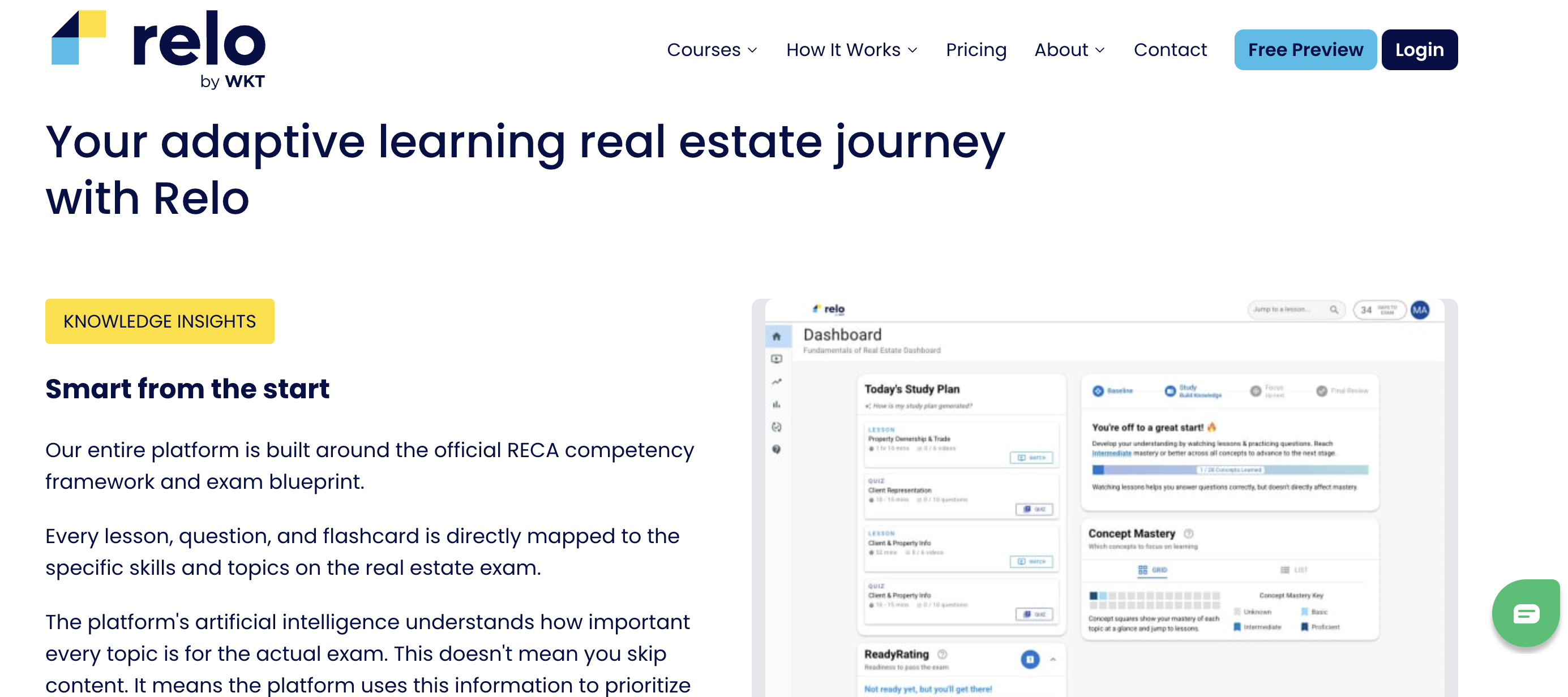
Deployed, not conceptual. The engine runs live today under our own regulated brands, with paying learners, the public storefront at relo.ca and the ReadyEngine™ study plan behind it.

The pipeline isn’t short of people. It’s short of proof.
Canada is filling the pipeline, a record 101,541 new apprenticeship registrations last year. But registrations are the entrance. At the exit, the certifying exam, Ontario’s overall pass rate across trades with certifying exams was 44.5% (Skilled Trades Ontario Annual Report 2023–24), and 30.9% of apprentices discontinue before they ever reach it. The failure is at the exit, not the entrance.
The money and the law already exist. The gap is the instrument.
Team Canada Strong (April 2026) commits $6B toward 80,000 to 100,000 new Red Seal workers by 2030–31, including $331M to expedite certification and $3.4B in completion supports. Legislation and interprovincial labour-mobility commitments are moving in the same direction. What no program has is a way to see, per worker, who is ready and what is missing.
Five levers toward 100,000 skilled workers by 2030–31.
The exam gap is the layer we can already price. The next four stack on top of it. The exam is the floor of the ambition, not the ceiling.
The workers are out there. The engine finds them, readies them, and proves it. The rest is will.