Proof of qualification is going digital. Trust hasn't caught up.
Ontario’s public register answers the compulsory-trade question, free and in seconds. It cannot travel: an employer in another province has no standing way to check an Ontario certificate, and a register lookup proves a record exists, not that the person holding the card is the person in the record.
A paper certificate or a PDF can be altered, with no fast way to tell a real one from a forgery. A verifiable credential fails verification the moment it is tampered with.
Proof earned with one provider, in one province, too often has to be re-proven in the next. Canada has committed to reducing exactly this friction at provincial lines.

- STO remains the issuer. It decides what is issued, to whom, and on what terms.
- STO can revoke or suspend, and the credential reflects it.
- There is no central database of credentials, and the network operator cannot see who verifies what.
- The verifier gets proof, not personal data.
- Nothing is compelled. Participation is per-issuer and per-credential. Joining for one credential commits you to nothing else.
- The public register stays the public register — Oliu is a verification layer over STO’s authority, not a replacement for it.
- The network is governed by an independent not-for-profit trust authority with termination rights over the operator. No single vendor can capture it.
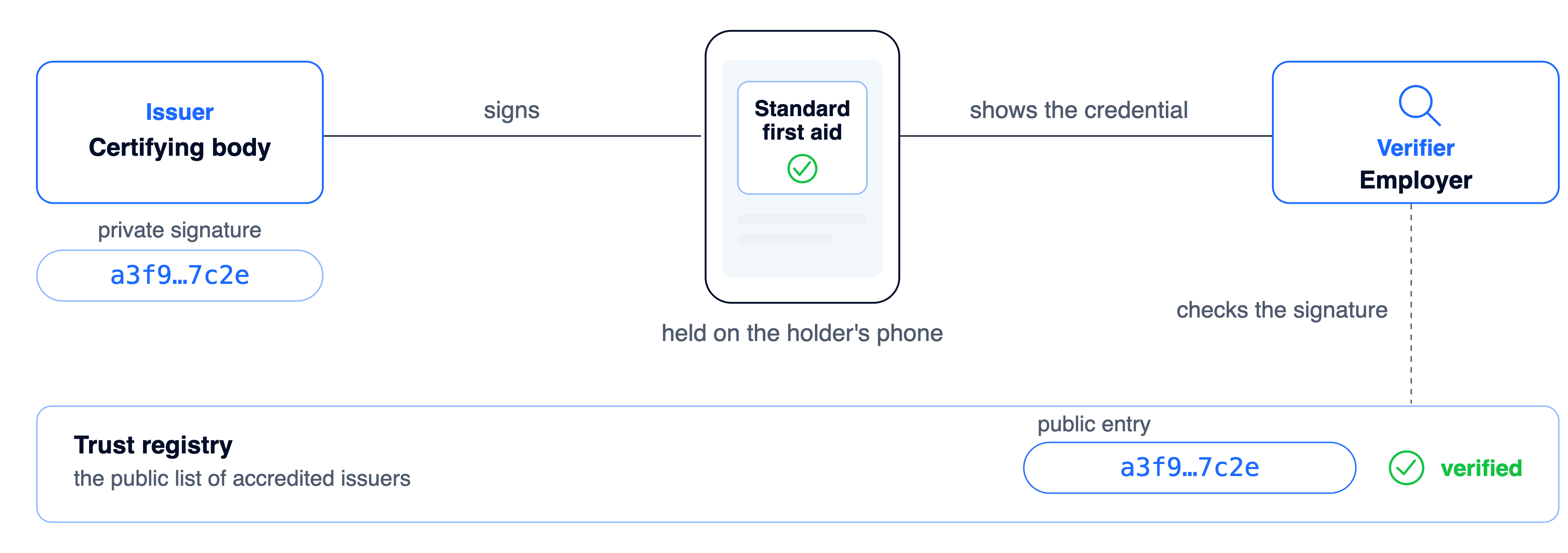
Three roles, one trusted connection.
A verifiable credential is the digital version of a certificate, with one difference: it is signed so it cannot be faked, and anyone with a legitimate reason can confirm it is real in seconds.
Grants the credential and decides what to issue, to whom, and on what terms. For a safety certificate, that is the certifying body, and it stays that way.
Keeps the credential in a free wallet on their own phone, unlocked with the same Face ID they already use for banking. They control when it is shared, and with whom.
An employer, a site supervisor, a regulator, anyone with a legitimate need gets a yes or no in seconds, without calling the issuer.
Like a passport, but the holder decides what the officer sees, one thing proven, without revealing everything else.
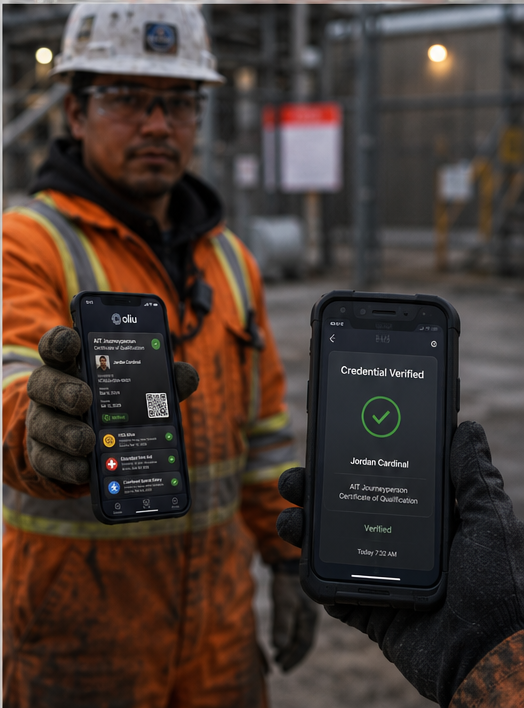
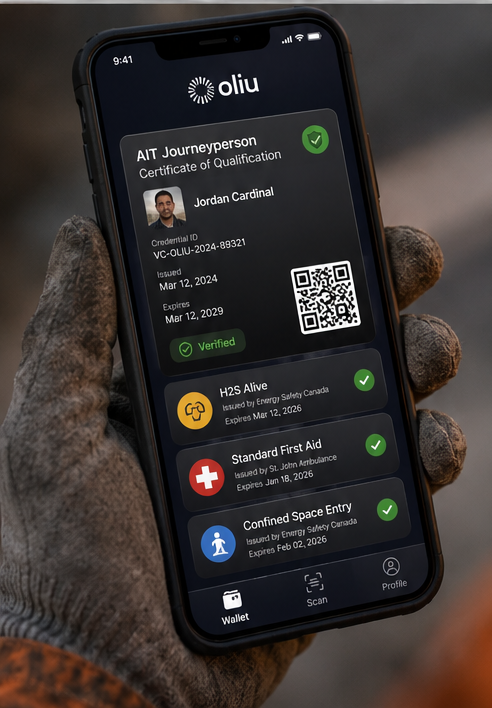
Credentials live in a free wallet on the holder's phone, unlocked with the same Face ID or fingerprint they already use for banking. The biometric never leaves the phone; the network never sees it. Built and hosted 100% in Canada.
 VERIFIABLE CREDENTIALS
 PAN-CANADIAN TRUST FRAMEWORK
 DIGITAL GOVERNANCE STANDARDS
 DIACC PCTF CERTIFIED
Deemed certification runs on a 10-business-day clock.
Ontario’s O. Reg. 199/25 (Deemed Certification), in force 1 January 2026 under the Ontario Labour Mobility Act, 2009 and enabled by Bill 2, the Protect Ontario Through Free Trade Within Canada Act, 2025, requires a regulator to issue notice of receipt within 10 business days of an application. The applicant is then deemed certified for a single, non-renewable six-month period and may work immediately, while the standard decision is still due within 30 calendar days (O. Reg. 199/25, in force 1 Jan 2026).
Federally, the Free Trade and Labour Mobility in Canada Act, part of the One Canadian Economy Act, received Royal Assent 26 June 2025 and comes into force 1 January 2026 (Royal Assent 26 Jun 2025, in force 1 Jan 2026). Stated precisely: it removes federal barriers, so a provincial credential is recognized for federally regulated work. It does not compel one province to recognize another’s credential automatically.
Put together, a 10-business-day notice clock is a verification problem before it is anything else. Instant, tamper-evident proof of a current Certificate of Qualification is how that clock gets met without adding risk.
Built for the verification you already carry.
As-of-right practice and trade-equivalency assessment put a real verification load on a regulator: confirming licensure, checking equivalency, validating work permits — case by case, by hand. A verifiable credential does not remove the regulator’s judgement; it removes the manual re-checking. The certificate proves itself, instantly, to whoever has a legitimate need — while STO decides what is issued, to whom, and on what terms.
Trust is the product, so trust is governed independently.
The issuers govern the standard. An independent not-for-profit owns and enforces it. A partnership corporation operates the network under contract. Three tiers, one accountability chain, designed so the network outlives any single vendor.
Regulators, professional bodies, industry associations, and commercial training providers across Canada who issue credentials through the network.
- Owns the open standards
- Enforces the protocol
- Sets accreditation criteria
- Runs the trust registry
Builds and runs the wallet, the issuer tooling, and the verification rails under contract to the Alliance, with reviews and termination rights held by the standard-holder.

The network survives the operator, by design. No single vendor can capture it, because the standard, the registry, and the accreditation criteria are held by an independent body accountable to the issuers themselves.
The first movers set the standard.
A group of respected credentialing authorities has convened to explore shaping the Alliance and its standards. Nothing is settled yet, these are the kinds of organizations that would form the foundation of an independent governance body, and they chose to be part of the conversation early. Joining early means helping write the rules, not inheriting them.







The standard is ready. The rooms that matter already know this work.
Invited to speak in the Senate during the Canada–EU discussion on interoperable credentials. Engaged with DIACC and the Digital Governance Standards Institute. In conversation with ministers of labour, federally and provincially.
The wallet is designed to work alongside the foundational digital-identity wallets provinces are developing, not in competition with them.
Readiness intelligence tells Skilled Trades Ontario who is ready. The trust network makes that proof portable. Together they cover both halves of the mandate: certify against the standard, and let the certificate travel.
Credentials are going digital either way. The only question is who makes sure it’s done right.
A background paper on credential portability across Canadian jurisdictions, prepared for tabling with the CCDA.
The problem, the standard, what stays with the issuer, and how the network is governed.